Interrogating Design Homogenization in Web Vibe Coding
arXiv preprint arXiv:2603.13036
Abstract
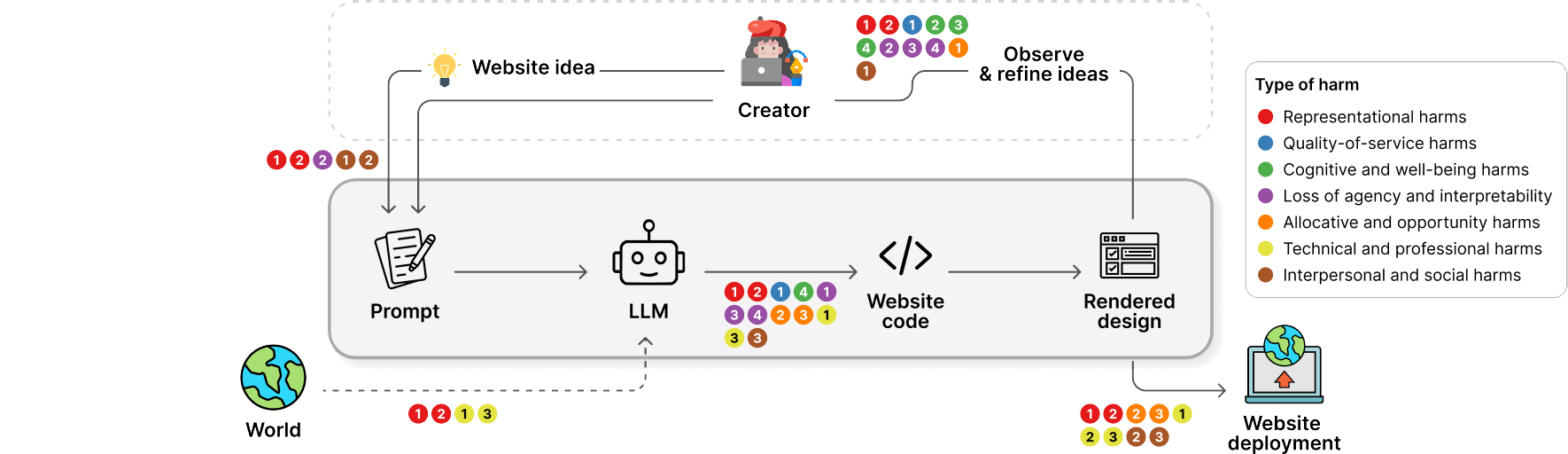
Generative AI is known for its tendency to homogenize, often reproducing dominant style conventions found in training data. However, it remains unclear how these homogenizing effects extend to complex structural tasks like web design. As lay creators increasingly turn to LLMs to ‘vibe-code’ websites—prompting for aesthetic and functional goals rather than writing code—they may inadvertently narrow the diversity of their designs, and limit creative expression throughout the internet. In this paper, we interrogate the possibility of design homogenization in web vibe coding. We first characterize the vibe coding lifecycle, pinpointing stages where homogenization risks may arise. We then conduct a sociotechnical risk analysis unpacking the potential harms of web vibe coding and their interaction with design homogenization. We identify that the push for frictionless generation can exacerbate homogenization and its harms. Finally, we propose a mitigation framework centered on the idea of productive friction. Through case studies at the micro, meso, and macro levels, we show how centering productive friction can empower creators to challenge default outputs and preserve diverse expression in AI-mediated web design.
Materials